

Understanding Alaska’s Totem Poles
I was around five the first time I recall visiting Sitka. My childhood was spent in Yakutat, a small fishing village on the coast of Southeast Alaska, and Sitka was one of the nearest “cities” we visited.
I vividly remember Sitka National Historical Park, both a visitor attraction and a place where locals walk to get their steps in. Along its Totem Trail and adjacent visitor-center grounds stand 18 totem poles. The historic collection came from Tlingit and Haida villages elsewhere in Southeast Alaska, with poles installed along the trail in 1906. Later carvings have added to the collection. Yakutat, when I lived there, had no totem poles, so encountering them was a new experience.
As a small girl, I felt even smaller as I walked the trail beneath towering spruce, hemlock, and red alder trees. Standing beside totems three feet wide and thirty feet high, I tipped my head back to follow the carved figures. Met with strange faces with large eyes and tongues protruding, I had a hard time deciphering what I was looking at. Some images resembled frogs and others resembled ravens. Admittedly, the poles frightened me as a child; without knowing the stories they carried, I saw only unfamiliar carved creatures looming above me, their meaning a mystery.

Forty years later, my experience is very different. As a Tlingit artist working in jewelry, installation art, and graphic design, I use formline—the distinctive visual language of Northwest Coast Native art that also appears on totem poles. I now recognize connections to ancestral stories, Tlingit and Haida histories, and my own identity as an Alaska Native. Where my five-year-old self saw unfamiliar creatures, I see stories, history, and craftsmanship, and the discipline of the artists who carved them. The poles that once frightened me now inspire me to share our cultural stories, pass on knowledge, and continue refining my craft.
As an artist, filmmaker, and cultural educator, I wonder what visitors feel when they encounter these towering figures at the forest’s edge. Do they feel the uncertainty I felt as a child, or a sense of wonder and reverence? Has someone helped them understand whose stories they are seeing?

Who makes the totem poles you see in Alaska?
Totem poles are created by the Tlingit, Haida, and Tsimshian peoples of Southeast Alaska. The tradition also belongs to distinct Northwest Coast peoples in British Columbia and Washington, whose styles and practices vary.
Because wood deteriorates in the coastal climate, surviving poles do not provide a complete record of the tradition’s age. Carved poles and house posts were documented by European visitors in the late 1700s, but the tradition predates those encounters. Its exact beginnings are difficult to date.

What is a totem pole?
A totem pole is a monumental carving that gives visible form to the histories, identities, and relationships of the people it represents. Through carved figures and crests, a pole may tell an ancestral story, identify a clan or house, honor someone’s life, or commemorate an important event. Each has its own purpose and meaning.
In Tlingit culture, a clan is an extended kinship group, and a person belongs to their mother’s clan. Clan crests express ancestral relationships and histories. Figures such as an Eagle, Bear, or Killer Whale can represent these inherited connections; their meaning depends on the clan and story associated with them.
Understanding a pole goes beyond identifying its figures. It begins with learning about the people connected to it.
Creating a pole involves much more than carving a design into a tree. Its size, complexity, and the work of planning, preparing the log, and raising the finished pole all shape the project. Master carvers may work with apprentices, passing on skills and knowledge through the process.
As a Tlingit artist, I understand spirituality as intertwined with culture, relationships, and place. The tree, the carving, and the people connected to a pole are part of that relationship. Ceremonies surrounding its creation and raising give expression to those connections, with practices guided by the community involved.

Poles serve different purposes:
- Crest or ancestry poles identify families or clans through inherited crests.
- History or story poles represent clan histories, ancestral narratives, or significant experiences.
- Memorial poles honor a person’s life and memory; some honor living people.
- Mortuary poles traditionally held human remains or cremated ashes.
- House posts serve as carved structural supports inside houses.
- House frontal or doorway poles stand near house entrances; some incorporate an entrance through the pole.
- Shame poles publicly call attention to wrongdoing or unresolved obligations.
These descriptions can overlap: a house frontal pole may also display clan crests and history. Contemporary poles continue these purposes while commemorating present-day events and relationships. In Sitka’s park, the Holding Hands Centennial Pole, designed by Tlingit master carver Tommy Joseph and raised in 2011, commemorates the park’s centennial. A newly carved pole is part of a living tradition.

What is totem pole etiquette?
Consider a totem pole an invitation to learn about the people whose homeland you are visiting. Pause before taking a photograph. Look closely at the figures, lines, shapes, and care of the artist’s work. Read the accompanying sign. Who carved this pole? Who does it represent? Why was it raised?
Recognizing a Raven, Eagle, or Wolf is a beginning, but knowing its name does not reveal the story. An Alaska Native-led tour, cultural center, or interpretation shared by the community can help you understand the relationships and histories expressed in the carving. Let curiosity carry you beyond the pole and into learning about the living cultures around you.
Photographs can be meaningful reminders of your visit. Follow local guidance, leave space around the pole, and refrain from touching or climbing it. Treat it with the care you would bring to a place of remembrance.
You do not need to arrive knowing every story. Come willing to listen, and you may leave seeing more than you did when you first stood beneath the figures.

Where can I see totem poles?
Across Southeast Alaska, visitors can encounter poles in forests, along waterfronts, and within cultural centers. Here are some highlights:
- In Sitka, walk the Totem Trail at Sitka National Historical Park. Visit the visitor center to see original carvings and learn how the collection came to Sitka.
- In the Ketchikan area, visit Totem Bight State Historical Park and Saxman Totem Park. The Totem Heritage Center preserves historic poles indoors, offering a close look at earlier generations’ work.
- In Juneau, explore Kootéeyaa Deiyí, the waterfront Totem Pole Trail developed by Sealaska Heritage Institute. Its contemporary poles reflect Tlingit, Haida, and Tsimshian clan histories, crests, and migrations.
- On Prince of Wales Island, the Organized Village of Kasaan offers guided visits to its Totem Park and Náay I’waans Whale House, an opportunity to learn about the site’s Haida heritage with a local guide.
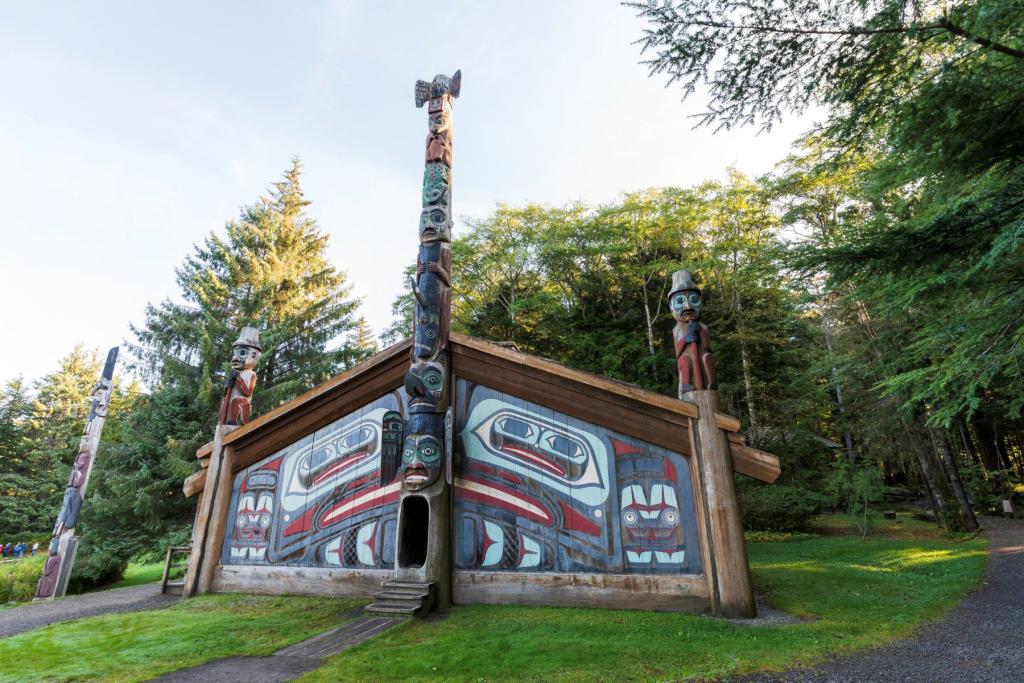
I think back to that little girl gazing up at the carved figures that once felt unfamiliar and strange. Today, when I look up, I feel a sense of connection and belonging. I love that there is still more to discover, that these poles invite us to learn about Tlingit, Haida, and Tsimshian stories and histories. My hope is that you, too, will find wonder in all they carry—that you will take a little time to listen to the stories shared with you and get to know the people whose histories these poles hold.


New! Alaska Native Culture Guide
Immerse yourself in Alaska Native heritage and learn how to experience the living culture of the state's Indigenous peoples.