

The Science Behind Alaska's Northern Lights
Most natural wonders stay still long enough for you to take them in; the northern lights don't. Whether a hazy glow on the northern horizon or a sudden curtain of green, purple, or red rolling overhead, the aurora borealis has captivated human beings for millennia; today, it draws thousands of travelers to high-latitude destinations every winter.
Understanding the science behind the aurora doesn’t make it any less magical; if anything, it makes the experience more meaningful. When you know what’s happening high above your head – and why certain places offer better viewing than others – you’re far more likely to plan a successful trip.
If you want to plan a trip to see the northern lights, Alaska belongs at the top of your list. Here's why – starting with the science.
What Causes the Northern Lights?
The northern lights are born on the surface of the sun. Our star constantly emits a stream of electrically charged particles (electrons and protons) called the solar wind. When particularly energetic events occur on the sun's surface, such as solar flares or coronal mass ejections, massive bursts of this plasma are hurled across space toward Earth.
When the solar wind reaches our planet, it encounters Earth's magnetosphere, which is the protective magnetic bubble generated by the movement of liquid iron in our planet's outer core. Most solar wind is deflected around Earth by the magnetosphere, but at the polar regions, the planet's magnetic field lines converge and dip toward the surface, creating a funnel through which charged particles can enter the upper atmosphere.
Once those particles from the sun spiral down to roughly 60 to 200 miles above Earth, they collide with oxygen and nitrogen atoms in our atmosphere. Those collisions excite the atoms to higher energy levels, and when the electrons in those atoms fall back to their normal state, they release that energy as visible light. That light is the aurora borealis, or northern lights, in the northern hemisphere. (In the southern hemisphere, they’re called the aurora australis or southern lights.)
Why Are the Northern Lights Different Colors?
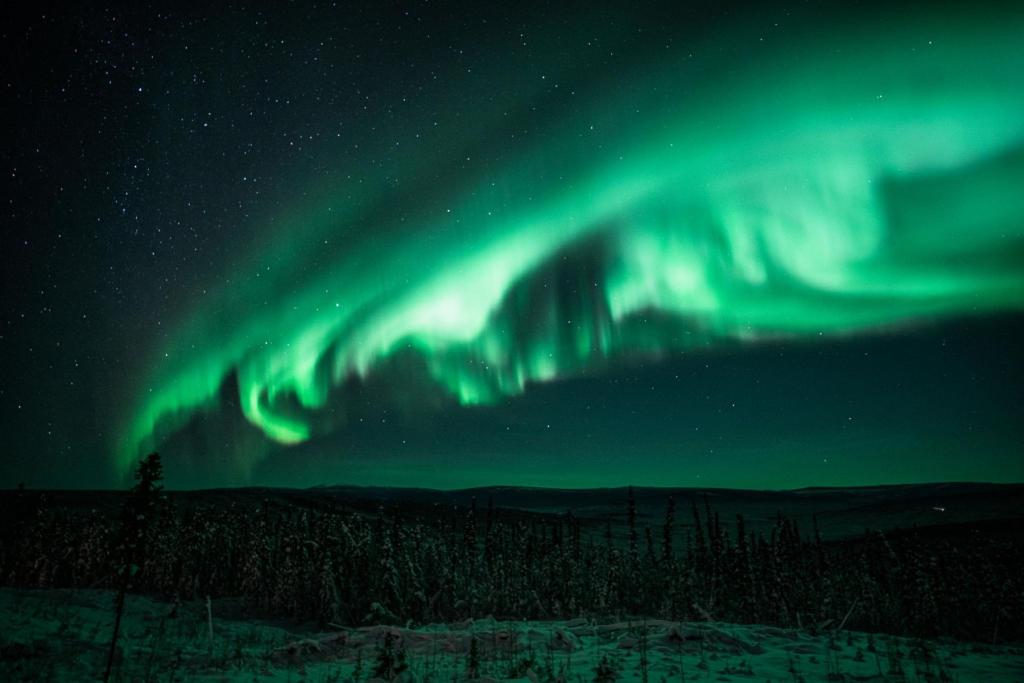
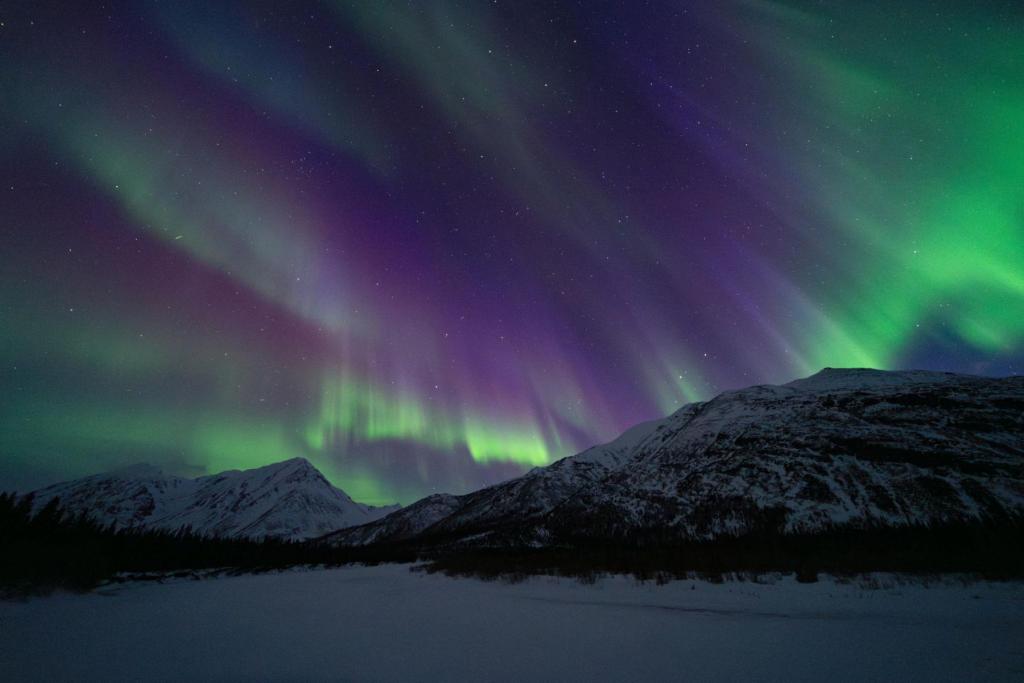
The colors you see depend on which gas is being excited and at what altitude. Oxygen at around 60 miles up produces the most common and recognizable color: a vivid green-yellow; higher up (around 200 miles above the earth), oxygen glows red. Nitrogen produces blues and purples. On a strong night, all of these colors can appear simultaneously, painting the sky in shifting ribbons and curtains of light.
What Do the Northern Lights Actually Look Like?
No photograph or description fully prepares you for seeing the aurora in person, but it helps to know what to expect. At its quietest, the aurora appears as a faint greenish arc stretching east to west across the northern sky, almost like the glow of a distant city. Easy to miss if you're not looking for it.
As geomagnetic activity increases, the arc brightens, develops texture, and begins to move. What starts as a still band may begin rippling, folding, and racing across the sky. At peak activity, the aurora can fill the entire sky, pulsing overhead in rays, spirals, and curtains that seem to defy physics. Seasoned aurora chasers describe this phase, called an auroral substorm, as one of the most breathtaking things a human being can witness.
Color perception also differs between human eyes and cameras. While long-exposure photography can capture saturated greens, reds, and purples, the naked eye may perceive weaker auroras as pale green or even grayish. Stronger displays, however, can be vividly colorful even without a camera. What makes the experience unforgettable isn’t just the color but the motion; auroras can shimmer, pulse, and intensify in a matter of minutes, creating a dynamic light show that feels almost alive.
When Can You See the Northern Lights in Alaska?
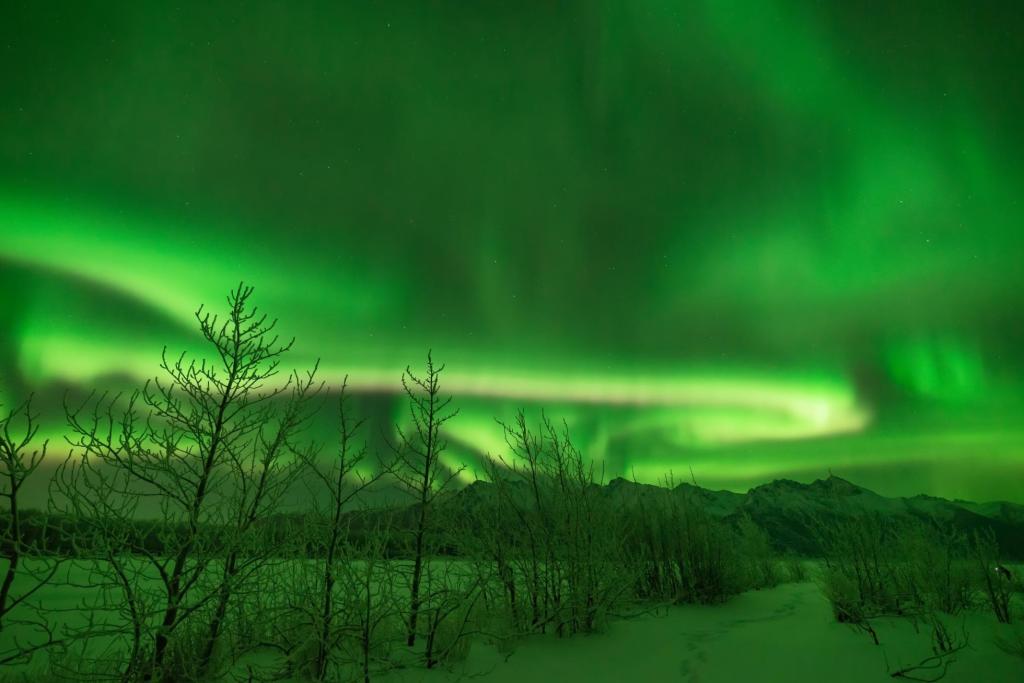
Aurora season in Alaska runs from late August through early April… basically, any time the nights are long enough and dark enough, there’s a chance to see “the lights.” The peak of the season is generally from November through February, when Alaska experiences its longest nights.
Outside of that window, the equinox periods (mid-to-late September and the same time in March) often produce heightened auroral activity due to the geometry of Earth's magnetic field relative to the sun. Many experienced aurora hunters deliberately plan trips during these windows, and these shoulder seasons can be great for avoiding the most dramatic winter weather, if that’s not part of what you hope to experience during your Alaska visit.
One other factor worth considering: we are currently in a particularly favorable moment in the solar cycle. Solar Cycle 25 reached its peak – called “solar maximum” – in late 2024, and scientists expect elevated auroral activity to continue through at least 2026. That means this coming aurora season is genuinely one of the best opportunities in roughly a decade to see an exceptional display.

What Are Aurora Forecasts, and How Can I Use Them?
Aurora forecasting is a branch of space weather science, and it has become increasingly accessible to travelers. The key tool is the Kp index, a global measurement of geomagnetic activity on a scale from 0 to 9, updated by NOAA's Space Weather Prediction Center (SWPC) every three hours.
For practical trip planning, here's what the Kp scale means for Alaska visitors: even at low Kp levels (2 or 3), the aurora can be visible above Alaska, particularly in Fairbanks, which sits right beneath the auroral oval. At Kp 5 and above, displays become dramatic and visible across most of the state. At Kp 7 or higher, the aurora can light up the entire sky and may even be visible in southern Alaska.
NOAA's Space Weather Prediction Center provides free 3-day Kp forecasts and a 30-minute aurora oval map updated every five minutes. For travelers, apps like SpaceWeatherLive and My Aurora Forecast (available for iOS and Android) provide user-friendly alerts and real-time data. The University of Alaska Fairbanks Geophysical Institute also publishes a dedicated Alaska aurora forecast.
Aurora forecasts are only one part of the equation, though. Seeing the northern lights requires a combination of strong solar activity, clear skies, and sufficient darkness. A high Kp index won’t matter if clouds roll in, just as perfectly clear skies won’t guarantee a display if solar activity is low. For travelers, the most effective approach is to monitor forecasts daily, pair them with local weather conditions, and be ready to head out when conditions align. Rather than relying on a single night, planning several opportunities to look for the aurora significantly improves your chances.
Why Is Alaska One of the Best Places in the World to View the Northern Lights?
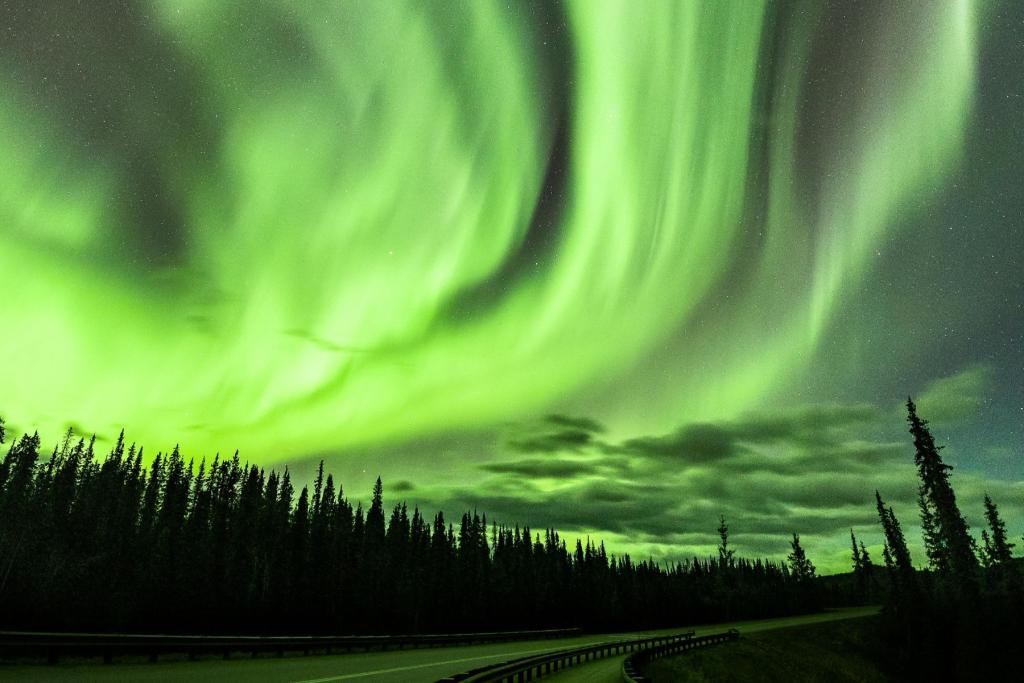
To understand why Alaska is exceptional for aurora viewing, it helps to know about the auroral oval, which is a ring-shaped zone around Earth's magnetic poles where the northern lights appear most frequently and most dramatically. Fairbanks sits almost directly beneath it. While observers in the continental U.S. or most of Europe have to look toward the horizon and hope for a strong enough solar storm to push the aurora south, visitors in Fairbanks look straight up.
For American travelers, Alaska removes a layer of logistical friction: no passport or visa needed, direct flights from major cities in the Lower 48, and a well-developed winter tourism infrastructure. You're not choosing between aurora quality and ease of access; in Alaska, you get both.
Add to that the sheer scale of Alaska's darkness. This is a state where you can drive 30 minutes from Anchorage and be genuinely, completely away from artificial light – and where Fairbanks and the Interior and Arctic regions offer skies dark enough to make a modest aurora display look extraordinary. That kind of darkness is harder to find in more densely populated aurora destinations, and it makes a measurable difference in what you see.
Of course, the northern lights don't run on a schedule, and that's part of what makes seeing them so rewarding. Give yourself several nights, get away from the lights of town, and check your forecast. When the sky starts to move, you'll understand immediately why people travel thousands of miles – and come back to do it again.


Alaska: AKA Your Next Adventure
Where will your Alaska adventure take you? Order our Official State of Alaska Vacation Planner and plot your course.