Chicken
Although it’s home to only about 10 year-round residents, Chicken has a lot to offer. The community is rich in gold mining history and ideally located to take advantage of the Fortymile Wild & Scenic River.
ABOUT CHICKEN
After crossing a bridge over Fortymile River’s Mosquito Fork, the Taylor Highway passes through Chicken, a regular stop for many traveling to Eagle or Dawson.
Gold mining began in the area in 1886 and within 10 years, a major prospect was discovered on the Upper Chicken Creek. Bob Mathieson’s discovery prompted him to quickly stake his claim and build a cabin. The area instantly became a hub of mining activity for the southern portion of the Fortymile Mining District with more than 700 miners working the streams between 1896 and 1898. According to legend, the town’s name originated at a meeting of the resident miners. When trying to come up with a name for the new tent city, somebody suggested “ptarmigan,” which are found in great numbers in the area. All the miners liked it, but none of them could spell it, so they settled on Chicken instead.
THINGS TO DO
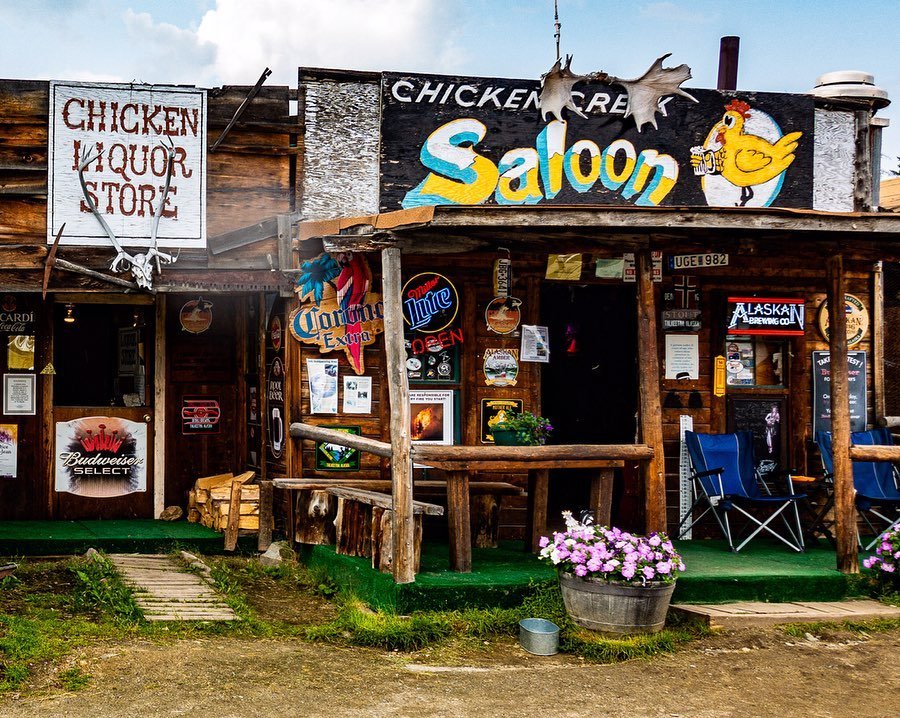
The community sits 300 yards up Airport Road, a spur road that leads to two RV parks/campgrounds, two cafes, gift shops, a very lively saloon, two gas stations, tours, gold panning, and recreational gold mining. During the summer, Chicken is an eclectic collection of miners, trappers, artists, wilderness adventurers, and travelers from around the globe. Every June the city is hosts Chickenstock, a weekend-long music festival featuring Alaskan artists, local food, and games.
The town still services gold miners from the Fortymile Mining District and provides a number of mining opportunities for visitors, including recreational mining and guided tours of the dredges. Most of the original buildings of Chicken are private, but for a fascinating lesson in the gold mining history of this community you can join a guided historic walking tour of the city led by locals.
The 1906-era Chicken Creek Hotel still stands today along with a dozen other buildings of that era. The Pedro Dredge, now a National Historic Site, originally was used for mining in the Fairbanks area before it moved to Chicken in 1959. The dredge is one of a few in the state that is open to the public.
Float trips on the Fortymile National Wild and Scenic River offer excellent wilderness scenery, solitude, and glimpses of gold-mining dredges, turn-of-the-century trapper cabins, and abandoned townsites. Many canoeists paddle the 40 miles from South Fork bridge east of Chicken to the bridge over O'Brien Creek, at Mile 113 of Taylor Highway. This two- to three-day trip involves three sets of Class III rapids.
Plan Your Trip
There are currently no listings that meet this criteria at this time.

Local Climate & Weather
For Alaska's day-to-day weather, it’s best to plan for a bit of everything. Learn more about weather in this area.
Trip Inspiration
#TravelAlaska
#TravelAlaska
 @halejosh
 @jutta.on.the.road
 @alturabistro
 @rvinginthewild
 @tobitheis